
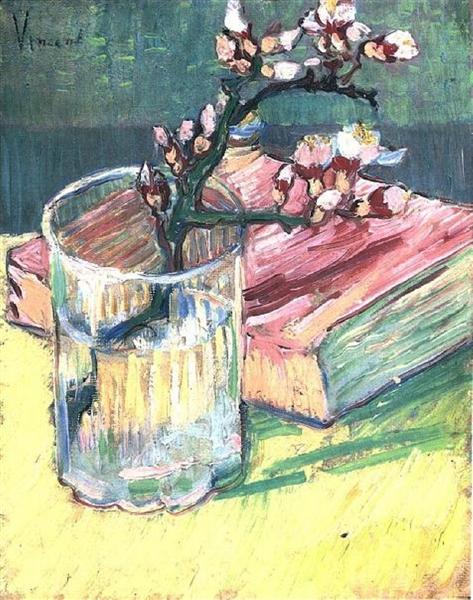
Vincent van Gogh, Blossoming Almond Branch in a Glass with a Book, 1888, oil on canves, Arles, France.
Several times this month I heard the excuse, ‘well, it’s a short month.’ I even said it myself in the last few weeks. And every time it makes me laugh. Really, two days make a lot of difference to some of us.
Yet, I haven’t quite finished the books I wanted to read in February, and two more days would make that goal easy. I’ll tell you about them even if I’m not quite to the last page.
The Hobbit: Bookclub and a Classic
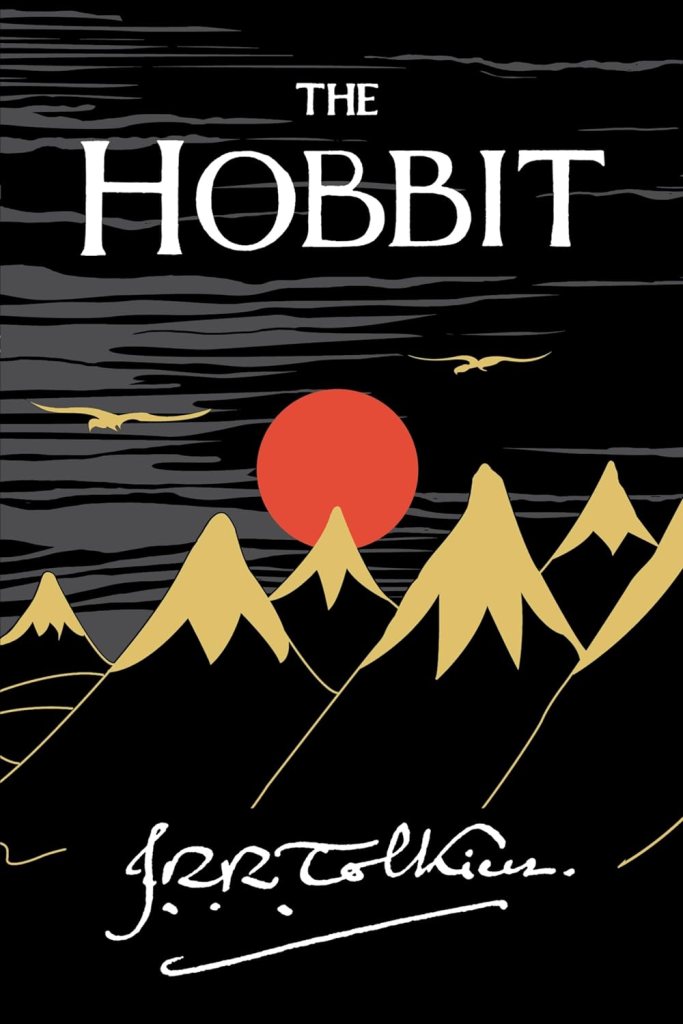
The Hobbit by J. R. R. Tolkien, 1937, 320 pages
I feel intimidated to review this book, mostly because there has been so much written about Middle-Earth and Tolkien, and there won’t be anything new to read here. But in case you’ve been living in a hole, and have yet to meet Bilbo, I’ll tell you what I know about The Hobbit.
The Hobbit is a fantasy, a comic epic with a playful humorous tone. It took a bit for me to get into it, as this is not my usual genre. It’s classified in the Junior section of my library, yet all the characters are middle aged or older. First, I divided the pages by days in the month and realized I needed to read twelve pages a day to finish before the next book club. But midway, the story caught hold of my imagination and I was reading for enjoyment.
Bilbo is a complacent hobbit, loving his easy life in Bag-End, and his many sumptuous meals. He is compelled by the wizard, Gandalf, to go along with a band of dwarves searching for treasure that had been stolen by the dragon, Smaug. At first Bilbo is timid and uncertain; he faints when they encournter their first peril. As the quest continues, he learns to take initiative and finds inner resources he didn’t know he had (but probably inherited from the Took side of the family).
When the band of dwarves and one hobbit reach the Lonely Mountain and encounter Smaug, a dreadful battle ensues that involves men, elves, dwarves and eagles against the goblins and wargs. Bilbo realizes that the truly heroic path ends in peace, not power, and he is now brave enough to act on what he sees is right.
The ending relieved me of all the cliches in the rest of it. I was truly surprised at Bilbo’s use of the Arkenstone. After it happened, I realized there had been much foreshadowing to warn me. And once again, I had the urge to go back to the beginning and start over, to pay better attention to the finer points.
The dwarves’ songs are recorded in this book. One of them I really like and would someone please compose a dwarvish tune so I can sing it?
The wind was on the withered heath,
but in the forest stirred no leaf:
there shadows lay by night and day,
and dark things silent crept beneath.

The wind came down from mountains cold,
and like a tide it roared and rolled;
the branches groaned, the forest moaned,
and leaves were laid upon the mould.

The wind went on from West to East;
all movement in the forest ceased;
but shrill and harsh across the march
its whistling voices were released.

The grasses hissed, their tassels bent,
the reeds were rattling— on it went
o'er shaken pool under heaven cool
where racing clouds were torn and rent.

It passed the lonely Mountain bare
and swept above the dragon's lair:
there black and dark lay boulders stark
and flying smoke was in the air.

It left the world and took its flight
over the wide seas of the night.
The moon set sail upon the gale
and stars wer fanned to leaping light.
--Tolkien
Treasure Island: Read Your Bookshelf and a Classic
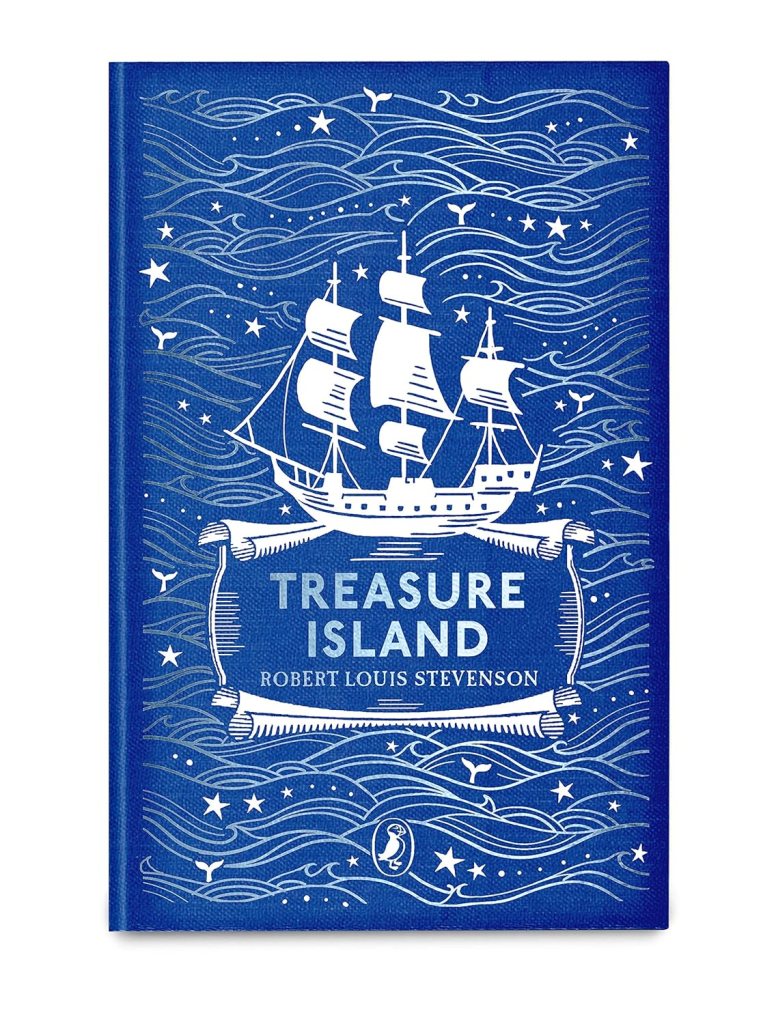
Treasure Island, Robert Louis Stevenson, 1883, 223 pages
Robert Louis Stevenson was drawing with his stepson one rainy summer afternoon. He sketched an island and began filling in the details of harbors and mountians. As he drew, names came to him like Jim Hawkins, Squire Trelawney, and Captain Smollet. A story began to form in his mind and he turned from drawing to writing. He wrote a chapter a day for two weeks and then was struck with writer’s block at Chapter 15. For a time, he couldn’t figure out how to get Jim off the island. Stevenson references Blackbeard, William Kidd and Bartholomew Roberts, real historical pirates, in this story. He also used suggestion from his father, as the family was reading along as the story developed.
It was originally serialized in a magazine between 1881 and 1882. The name was later changed to Treasure Island.
Treasure Island is a coming-of-age story with many moral complexities. It’s famous villian has been a pattern for many pirate stories since. The violence shocked the original readers in their day, and I’d say it’s still pretty awful. So be forewarned! I was surprised as I thought this was a children’s classic. There’s plenty of shooting and stabbing but not a lot of blood and gore.
At this time I am just over half way throughTreasure Island. It feels familiar, like I have read it before. Yet I’m not sure I actually have. That’s the puzzle with classics — some are spoken of or referenced enough that we think we’ve read them. And it’s also a good reason to read them — to know the whole story, not just the things most often refernced- like Long John Silver. I’d heard of him before. I never knew he was so charming, cunning and ruthless.
I hope to finish this in the next few days.
Van Gogh Has a Broken Heart: WOTY Book
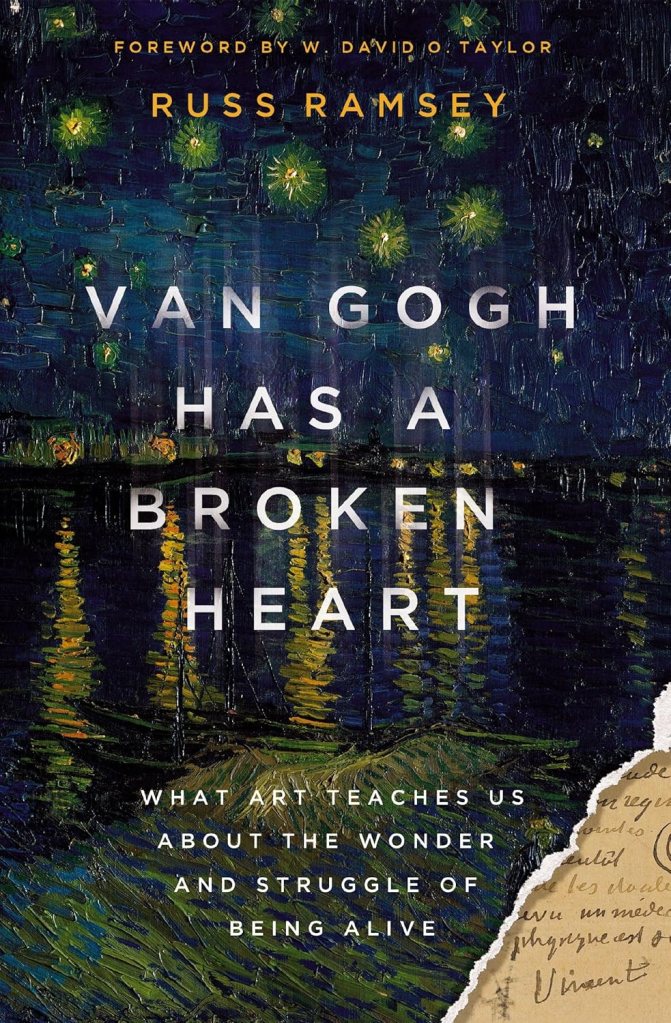
Van Gogh Has a Broken Heart, Russ Ramsey, 2024, 211 pages
Since two books filled three of my reading categories, I added another book to go along with beauty, my word of the year.
Van Gogh Has a Broken Heart contains ten chapters, each one telling the story of an artist and his work along with the author’s connection to and observations about the work. After reading this book, Ramsey hopes the reader will feel brave enough to look at art and say, “I like this one”, or “I don’t like this one”, or “I don’t understand this one.” There are many styles of art and many kinds of people, but beauty is something we should respond to. He wants to introduce us to many artists, hoping we find one we feel a connection to, and can pay attention to for the rest of our lives.
Art shows us back to ourselves, and the best art doesn’t flinch or look away. Rather it acknowledges the complexity of struggles like poverty, weariness, and grief while defiantly holdng forth beauty – reminding us that beauty is both scarce and everywhere we look. – Russ Ramsey
After reading this book, I looked around at the art/plaques in my house and wondered why I would waste valuable wall space on second-rate stuff. I have one that qualifies- a matted and framed poster of Starry Night in my library, but what’s to stop me from hanging Christ in the Storm over my kitchen sink, Storm in the Rocky Mountains over my bed (in reduced size) or a certain windy Grandma Moses landscape that I love in the laundry room?
And there I just experienced something Ramsey talked about in the book: if we see something beautiful, our first impulse is to own it. Yet he encourages us to build our ‘personal collection’ and go see it at the museum. And when I reread the former paragraph, I wonder if I like stormy scenes?
I had some new thoughts about beauty. The beauty of nature can be so sublime it is fearful. Ramsey describes it as ‘a sort of delightful horror.’ And so much of the time beauty is born out of suffering. Beauty pulls us to ‘the truth that we were made to exist in the presence of glory,’ yet we are ‘aware that there is something in us that is unable to behold the glory in full.’
This book reminded me that I like Van Gogh. And it introduced me to Bierstadt, who might become another favorite. His painting reminds me of pictures that used to hang in my grandparents basement bedrooms – scenes with long views of valleys, mountains and skies with clouds. I wonder now if they were replicas of Hudson River School painters, but I will never know because my grandparents are gone and those pictures are in the wind, at least to me.
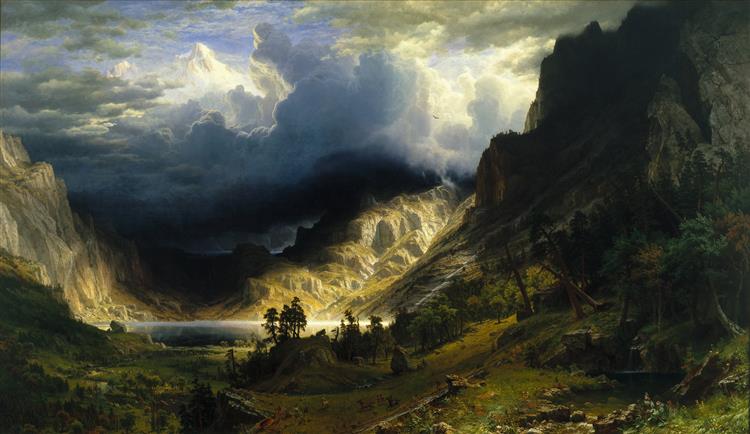
Albert Bierstadt, A Storm in the Rocky Mountians, Mt. Rosalie, 1866, oil on canvas in the Brooklyn Museum, Brooklyn, NY.
I hope you introduce me to some more art that I can love. Share your personal collection in the comments. Or tell us about the books you read in February.
–Liz
 So She Reads
4 responses to “The Bookmark: February”
It’s been a while since I read The Hobbit, but I so identify with Bilbo, wanting my cozy home and books and being perfectly content without adventure. 🙂 I don’t think I have ever read Treasure Island, though the characters’ names are familiar. I loved Van Gogh Has a Broken Heart, as well as Ramsey’s first book like this, Rembrandt Is In the Wind.
…and his cozy tea times. Who did all the cooking? And yes, I want to read Rembrandt Is In The Wind as soon as the library can get it for me. Thanks for reading and commenting, Barbara.
The Hobbit was one of Mario’s favorite books!
Cecile, I’d love to be able to hear what he would say about it. I can imagine that would be an intersting discussion!