cur·mudg·eon  /kərˈməj(ə)n/  noun
a bad-tempered person, especially an old one.
The curmudgeons:
Ove. 59 years old. Sad, cranky, unlikeable.
Harold. 65 years old. Stifled, unsure, unemotional. But he walks to Berwick-upon-Tweed.
Eleanor. 29 years old, but seems much older. Misfit, traumatised, lonely.
Major Pettigrew. 68 years old. British Army Officer. Starchy. Correct.
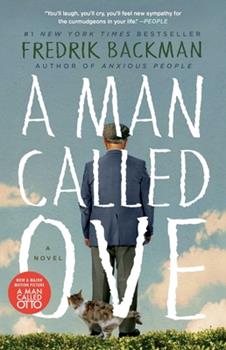
A Man Called Ove by Frederik Backman
According to Wikepedia: “Backman got his inspiration for this book after reading an article about a man named Ove who had a fit while buying tickets at an art museum. Backman instantly related to this man as he claims to be “not great at talking to people”. He started writing blog posts under the heading, “I am a Man Called Ove”, where he wrote about his pet peeves and annoyances. Eventually, he realized that his writing had potential for the creation of an interesting fictional character.”
Ove is a curmudgeon—the kind of man who points at people he dislikes as if they were burglars caught outside his bedroom window. He has staunch principles, strict routines, and a short fuse. People call him ‘the bitter neighbour.’ However, behind the cranky exterior there is a story and a sadness. So when one November morning a chatty young couple with two chatty young daughters move in next door and accidentally flatten Ove’s mailbox, it is the lead-in to a comical and heart-warming tale of unkempt cats, unexpected friendship, and the ancient art of backing up a U-Haul. All of which will change one cranky old man and a local residents’ association to their very foundations.
My take on Ove
This book was unexpected. I did not expect to like Ove. I did not expect Ove to like his chatty neighbors. I did not expect the cat to be a freind. I certainly did not expect some of the things that I saw happening. The good part is that the nieghbor lady (very pregnant, by the way) kept interrupting Ove and distracting him from his sad life. All’s well that ends well with Ove.

Joyce first wrote the story of Harold Fry in the form of a short radio play, which was broadcast on BBC Radio 4. She dedicated the play to her father, who was dying from cancer, and who did not live long enough to hear it. The play was later developed into a full-length novel.
Harold Fry, 65, has cut the lawn outside his home at Kingsbridge on the south coast of Devon when he receives a letter. A colleague of twenty years ago, Queenie Hennessy, has cancer and is in a hospice in Berwick-upon-Tweed. The doctors say there is nothing more that can be done for her. He writes her a feeble and brief note and goes to post it, has second thoughts, and walks to the next post box, and the next. He phones the hospice from a call box and leaves a message. He is coming and she should wait, stay alive while he makes the journey. A girl at the petrol filling station where he stops for a snack says something that acts as a catalyst for his nascent project. He tells her he is on foot, posting a letter to someone with cancer. ‘If you have faith you can do anything’ she replies.
As he begins the walk—which in 87 days will cover 627 miles—he reflects. About his marriage, his former employment as a brewery representative, about his son David, from whom he is almost completely estranged. From stopping places he sends postcards, to his wife Maureen, to Queenie, and to the unnamed girl at the filling station who gave him inspiration for his journey.
My take on Harold
My sister told me about this book, so when we visited her house this summer I snitched it off her bookshelf. Then I got it read in about four days. I was baffled why a going-into-old-age man would take off walking, leaving his wife without somuch a by-your-leave. I was also baffled why his wife didn’t go after him in the car. That’s what I would have done, I’m sure. Thinking I was saving him, when in reality the walk did both him and her good and greatly improved their relationship. Note to self: If Weston wants to walk, let him walk. A favorite part of this book is how people joined him in his walk and how kind he was to them, even though he was totally irritated with all the attention and company. I loved the introspective aspect of this story. It resonated with me and even made me evaluate a few things in my own life. I loved Harold and his walk! It helped that he was walking to a place called Berwick-Upon-Tweed. I could even walk 627 miles if that was at the end.

Eleanor Oliphant, the novel’s protagonist and narrator, lives in Glasgow, Scotland, and works as a finance clerk. At the novel’s outset, she is 29 years old. She is academically intelligent. Every day on her lunch break she completes a crossword puzzle. However, she is socially awkward and leads a solitary lifestyle. She has no friends or social contacts, and every weekend consumes two bottles of vodka. She takes little interest in her appearance; she has not had a haircut since she was 13.
Not considering that she has a problem, Eleanor repeatedly describes herself as “absolutely fine”, and even when obvious moments of awkwardness arise in her interactions with others, she tends to blame the other person’s “underdeveloped social skills”.
Clues gradually emerge to Eleanor’s troubled past. She has a badly scarred face; knows nothing about her father; spent much of her childhood in foster care; and, as a student, spent two years living with an abusive boyfriend who regularly physically assaulted her. Her mother now appears to be confined to an unidentified institution: she phones Eleanor for a 15-minute conversation on Wednesday evenings. It is clear that Eleanor’s mother is both vindictive and manipulative.
After an extended absence from work, Eleanor is found by Raymond, sent by their boss to investigate. He helps her find herself, continuing to take care of and visit her often. He even brings her an abandoned cat for company, which Eleanor appreciates.
My take on Eleanor
Totally and thoroughly dislikable. My first impression and it didn’t change until the last few chapters of the book. Her relationship with her mother was a problem through the entire book and it was obvious that something needed to change there. The change came about and I totally was taken off guard when it all happened. All I can say is I hope Eleanor eventually found the peace she was looking for. (This book is worth reading, by the way.)

Love at first sight? A starchy retired British Army officer named Maj. Ernest Pettigrew has just learned of his brother Bertie’s death. Distracted by grief, he happens to be wearing a red, flowery housecoat when he answers a ring at his front door. He opens the door and casts a tearful eye on the dignified, elegant, foreign-looking woman who will win his heart.
Major Pettigrew dimly knows this woman as Mrs. Ali. She has been blending tea specially for him at the local convenience store. Since these two are not strangers, they cannot be experiencing love at first sight, even if discreet sparks fly between them. It’s the reader who is apt to be susceptible: read this one page, and you may find you’ve fallen head over heels for Ms. Simonson’s funny, barbed, delightfully winsome storytelling. Don’t say you weren’t warned.
That “Major Pettigrew’s Last Stand” opens at a moment of heartbreak has no sobering effect whatsoever. Grief is what it took to make the rigidly correct Major notice Mrs. Ali, or anything else around him. This 68-year-old widower, a man who has taken some of his greatest satisfaction in reading and rereading his will and is proud to grow a type of clematis vine that his neighbors think is worth stealing, has long been immune to human companionship. He has preferred a style of such extreme correctness and gimlet-eyed detachment that all it takes to give this book its comic perspective is to present his point of view.
My take on Major Pettigrew
While he was too worried with how things looked, I suppose he can be forgiven for that. He was, afterall, a retired British Army Officer and the Brits are known for a stiff upper lip. He had learned it well. The story is sweet and gentle. Even though I call him a curmudgeon, it’s only from the stiff upper lip standpoint. He is easy to like and he is kind to Mrs. Ali. If you are looking for an easy, love-in-later-life story this fall, look no further that Major Pettigrew.
The Hero

So, I searched my brain and my bookshelves for a book that I thought the protaganist qualified as a hero. I could not settle on a single book. I came across many that seemed to fit, but then I would start listing reasons why he just was too much of a real person.
Then I started evaluating what a hero should look like. Swooping in to save a damsel in distress. Killing the lion before it got to the tourists. Rescuing the cat from the burning house. Saving the day in spite of heated family arguments. Not breaking her heart. Not being afraid of commitment. (I’m beginning to see a trend here.)
Seriously, do we even have any heroes anymore?!
Your take on heroes
I need your help. My opinion of heroes is totally out of proportion. What do you think a hero should look like? Which books have you read that would have a protaganist that qualifies as a hero? Let us know in the comments what you think a hero looks like. Do you know any fictional or real life heroes?
 So She Reads
12 responses to “Four Curmudgeons and a Hero”
You should add Susan from The Cactus to this list of curmudgeons, Eva. I’d like to try Major Pettigrew!
I do not know Susan, but I will add her to my list!
My idea of a hero is anyone who is willing to take the kind approach to life. Always looking for ways to treat those they come in contact with in kindness and respect.
As for my favorite heroes in books, I guess I can’t really name any but again, the characters that stand out clearest to me are those who treat others with kindness, no matter their curmudgeonly attitude.
Heroes. Hero moments. Rudi in Banner in the sky when he forfets his chance at the top to help his fallen enemy . The Duke of rudling’s granddaughter in lassie come home, when she swings the gate open to allow lassie to run free. Kanana in The Lance of Kanana by harry french (a really favourite story btw) when he kills himself in the face of the misunderstanding of his country men who think he’s traitor , while meanwhile it’s his only chance to save his country. Mr Darcy in the circumstances of Elizabeth’s foolish sister. I think I’d call Barney a hero in The Blue Castle and also valancy.
Paul Gallico writes a haunting short story about a classic rescue-the- damsel-in-distress hero called The Doll. Agnes Sligh Turnbull writes a lovely short story about how a wife plays the hero role called When Queens Ride By
When I look at real people I’m like you. Real heroes? No one’s actually that noble. Sir Winston Churchill? But he had enough faults to discredit the hero status (in my mind) Mother Teresa? Too famous. Makes me skeptical. Princess Diana? Same. Too many faults n too famous … it’s be a good exercise for me to just focus on the hero moments or elements in anyone. Btw a good read is by Mary Soames, Winston Churchills daughter called A Daughter’s Tale.
There are so many books with heros! Corrie ten Boom in The Hiding Place.
Conor Grennan in Little Princes.
Kathy Harrison in One Small Boat.
Cathy Glass.
Kim and Krickett Carpenter in The Vow.
I realize these are all true stories. But I think most people are heros!
and one fiction story: Calico Joe. Joe is a hero and Warren and his son. They were able to apologize and forgive.
There are so many books with heros! Corrie ten Boom in The Hiding Place.
Conor Grennan in Little Princes.
Kathy Harrison in One Small Boat.
Cathy Glass.
Kim and Krickett Carpenter in The Vow.
I realize these are all true stories. But I think most people are heros!
and one fiction story: Calico Joe. Joe is a hero and Warren and his son. They were able to apologize and forgive.
Ok no hero springs to mind but you should definitely read and review The Rosie Project. It opened my mind to the world a person with asperbergers may inhabit.
Sean Dietrich writes about heroes all the time in his Sean of the South blog
Hmmmm. Curmudgeons are grumpy and mean, but in the end they turn out to be Not So Bad. Human.
Heroes are brave and strong. In my mind a hero doesn’t really have fears and weaknesses. Maybe that’s why it’s so hard to find one. Maybe it’s ok if our heroes have some fears and weaknesses and turn out to be human too. (I have to admit though, that’s a little hard for me to swallow. I like heroes that are, well, heroic. And I just thought of one. The Scarlet Pimpernel.)
Hmmm. Your curmudgeons are grumpy and mean, but in the end they turn out to be Not So Bad. Human.
Heroes are strong and brave, with no weaknesses or fears. Maybe that’s the problem. Maybe our heroes need to have some weaknesses and fears, to be human too. (I have to admit though, that’s hard for me to swallow. I love a good hero. And I just thought of one. The Scarlet Pimpernel.)