

Atul Atmaram Gawande (born November 5, 1965) is an American surgeon, writer, and public health researcher. He is married to Kathleen and they have three children. He practices general and endocrine surgery at Brigham and Women’s Hospital in Boston, Massachusetts. He is a professor in the Department of Health Policy and Management at the Harvard T.H. Chan School of Public Health and the Samuel O. Thier Professor of Surgery at Harvard Medical School.
He is the author of the books Complications: A Surgeon’s Notes on an Imperfect Science; Better: A Surgeon’s Notes on Performance; The Checklist Manifesto; and Being Mortal: Medicine and What Matters in the End.
I am drawn to medical books. They can be fiction or nonfiction; I like them all. I especially like them if they take a slightly different approach than the mainstream medicine of today. For instance, in these books Atul Gwande criticizes (in a respectful way) the downfalls of his profession. H stakes a step back and analyzes how things could be done differently or in a better way.
The first book of Atul Gwande’s that I read was Complications. It really caught my attention to have a surgeon writing about all the things that can and do go wrong in surgery. Next I read Being Mortal. This one is all about the end of life and how we can help make it better for the elderly in our lives. If you have elderly people in your life, I suggest you read this one to give yourself a different perspective on the sunset years. I am currently working on Better.
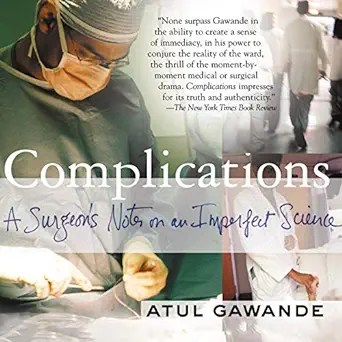
A brilliant and courageous doctor reveals, in gripping accounts of true cases, the power and limits of modern medicine.
Sometimes in medicine the only way to know what is truly going on in a patient is to operate, to look inside with one’s own eyes. This book is exploratory surgery on medicine itself, laying bare a science not in its idealized form, but as it actually is – complicated, perplexing, and profoundly human.
Atul Gawande offers an unflinching view from the scalpel’s edge, where science is ambiguous, information is limited, the stakes are high, yet decisions must be made. In dramatic and revealing stories of patients and doctors, he explores how deadly mistakes occur and why good surgeons go bad. He also shows us what happens when medicine comes up against the inexplicable: an architect with incapacitating back pain for which there is no physical cause; a young woman with nausea that won’t go away; a television newscaster whose blushing is so severe that she cannot do her job. Gawande offers a richly detailed portrait of the people and the science, even as he tackles the paradoxes and imperfections inherent in caring for human lives.
At once tough-minded and humane, Complications is a new kind of medical writing, nuanced and lucid, unafraid to confront the conflicts and uncertainties that lie at the heart of modern medicine, yet always alive to the possibilities of wisdom in this extraordinary endeavor. -Amazon
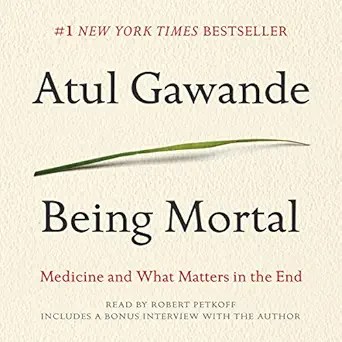
Medicine has triumphed in modern times, transforming the dangers of childbirth, injury, and disease from harrowing to manageable. But when it comes to the inescapable realities of aging and death, what medicine can do often runs counter to what it should.
Through eye-opening research and gripping stories of his own patients and family, Gawande reveals the suffering this dynamic has produced. Nursing homes, devoted above all to safety, battle with residents over the food they are allowed to eat and the choices they are allowed to make. Doctors, uncomfortable discussing patients’ anxieties about death, fall back on false hopes and treatments that are actually shortening lives instead of improving them.
In his bestselling books, Atul Gawande, a practicing surgeon, has fearlessly revealed the struggles of his profession. Here he examines its ultimate limitations and failures―in his own practices as well as others’―as life draws to a close. Riveting, honest, and humane, Being Mortal shows how the ultimate goal is not a good death but a good life―all the way to the very end. -Amazon
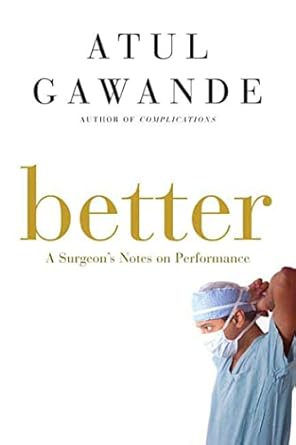
The New York Times bestselling author of Being Mortal and Complications examines, in riveting accounts of medical failure and triumph, how success is achieved in a complex and risk-filled profession
The struggle to perform well is universal: each one of us faces fatigue, limited resources, and imperfect abilities in whatever we do. But nowhere is this drive to do better more important than in medicine, where lives are on the line with every decision. In this book, Atul Gawande explores how doctors strive to close the gap between best intentions and best performance in the face of obstacles that sometimes seem insurmountable.
Gawande’s gripping stories of diligence, ingenuity, and what it means to do right by people take us to battlefield surgical tents in Iraq, to labor and delivery rooms in Boston, to a polio outbreak in India, and to malpractice courtrooms around the country. He discusses the ethical dilemmas of doctors’ participation in lethal injections, examines the influence of money on modern medicine, and recounts the astoundingly contentious history of hand washing. And as in all his writing, Gawande gives us an inside look at his own life as a practicing surgeon, offering a searingly honest firsthand account of work in a field where mistakes are both unavoidable and unthinkable.
At once unflinching and compassionate, Better is an exhilarating journey narrated by “arguably the best nonfiction doctor-writer around” (Salon). Gawande’s investigation into medical professionals and how they progress from merely good to great provides rare insight into the elements of success, illuminating every area of human endeavor.
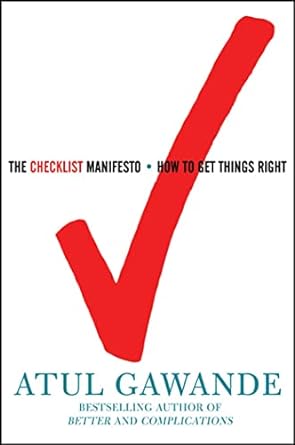
The New York Times bestselling author of Being Mortal and Complications reveals the surprising power of the ordinary checklist.
We live in a world of great and increasing complexity, where even the most expert professionals struggle to master the tasks they face. Longer training, ever more advanced technologies―neither seems to prevent grievous errors. But in a hopeful turn, acclaimed surgeon and writer Atul Gawande finds a remedy in the humblest and simplest of techniques: the checklist. First introduced decades ago by the U.S. Air Force, checklists have enabled pilots to fly aircraft of mind-boggling sophistication. Now innovative checklists are being adopted in hospitals around the world, helping doctors and nurses respond to everything from flu epidemics to avalanches. Even in the immensely complex world of surgery, a simple ninety-second variant has cut the rate of fatalities by more than a third.
In riveting stories, Gawande takes us from Austria, where an emergency checklist saved a drowning victim who had spent half an hour underwater, to Michigan, where a cleanliness checklist in intensive care units virtually eliminated a type of deadly hospital infection. He explains how checklists actually work to prompt striking and immediate improvements. And he follows the checklist revolution into fields well beyond medicine, from disaster response to investment banking, skyscraper construction, and businesses of all kinds.
An intellectual adventure in which lives are lost and saved and one simple idea makes a tremendous difference, The Checklist Manifesto is essential reading for anyone working to get things right.

Now it’s your turn. What are your favorite genres of books? Do you read medical books or is that something you stear clear of? Drop a couple of your favorite books in the comments, please, and tell me if you have read any of these books.
-Eva
 So She Reads
3 responses to “Author Spotlight: Atul Gwande”
In Shock by Dr Rana Awdish
I like to read medical books also have read several by nurses in the ER..
Great! I will look this one up, too! Thanks for the suggestion!
Thanks Eva! This does look this does look like a pretty good book. “Doctors, uncomfortable discussing patients’ anxieties about death, fall back on false hopes and treatments that are actually shortening lives instead of improving them.”