

There’s a local legend about a statician who kept track of songs sung in church at a particular congregation. On the spreadsheet, he found the most often led song was number 35, Come Thou Fount of Every Blessing. It was sung eight times over a span of five years.
Is that all the oftener we need to sing a song to have it almost-memorized? I wouldn’t doubt that collectively, as a congregation, we could sing number 35, and possibly half of the songs in the Christian Hymnal, by memory. Maybe we don’t have them totally memorized as individuals, but they are so familiar, we even hear the children singing along.
I heard a preschooler singing We’re Marching to Zion once. He couldn’t have heard the song more than eight times at church in his short life. How could he sing the tune and the words? I think it is some sort of miracle. Or have these songs become our DNA and are passed down along with eye color? No one can deny these songs are certainly a part of our cultural heritage.
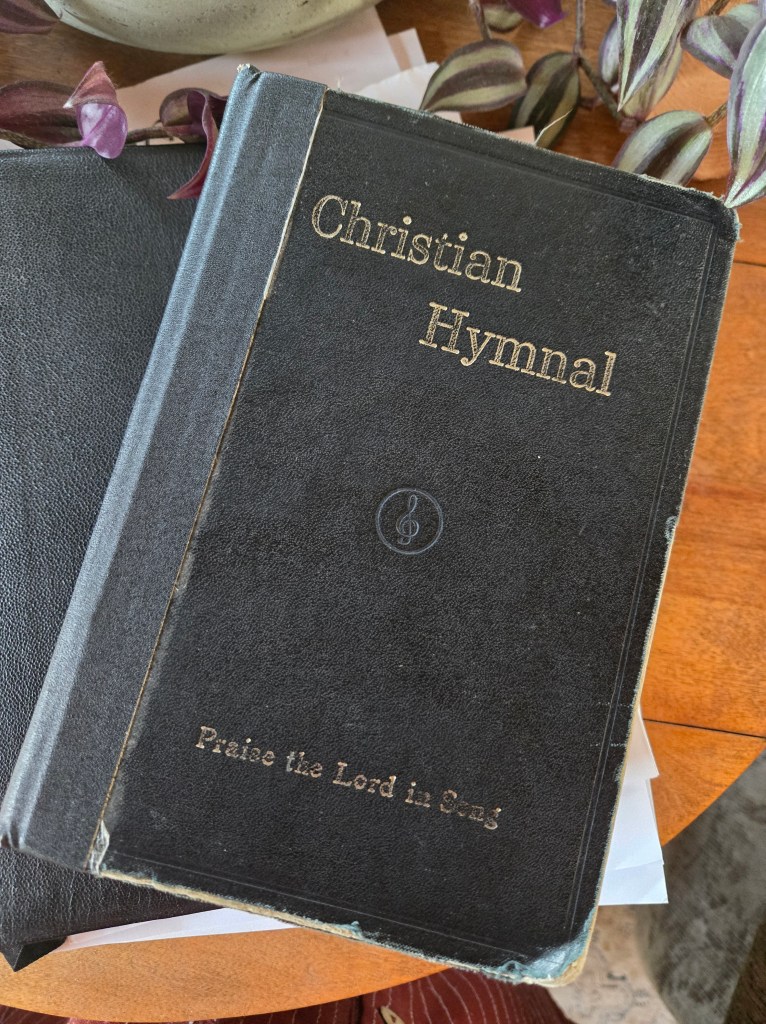
But once upon a time, there was no Christian Hymnal.
In the early 1940’s, the men and women who were to become our grandparents and great-grandparents saw the value of music in church services and wanted a collection of suitable hymns that could be distributed across the Mennonite congregations. In 1942, after a decision in conference, seven men got together to see what could be done about creating a hymnal.1 They brought together songs they thought appropriate: doctrinally sound, easy to sing, with simple harmony and avoiding much repetition. The goal was to have songs that represented the whole of Christian life. They also asked for contributions from the membership at large and a whopping 1500 songs were submitted for consideration.
These men began the huge, time-consuming task of singing the songs and trying them against their criteria. Sometimes words were altered slightly, and the revisions were submitted to the copyright owners for permission. Many letters were written to authors and printers for permission to print. They sang each song, discussing the pros and cons of including or excluding it in the collection.
Many of the copies submitted were sheet music and used round notes and they came from a wide variety of print sources. This presented a problem, as they wanted all the songs to be printed with simple, shaped notes and standardized text. Everything needed to be translated to shaped notes and this involved the use of printing plates made available by Stamps Baxter and Music and Printing Co. These quantities of shaped notes were then cut out and arranged on a staff with tweezers and secured with glue. There was no home copier or even computer to make the job easier.
(This is the standard explanation. I wonder why they couldn’t have simply drawn the notes instead of cutting them out, but maybe cutting was more uniform and precise. I don’t know the particulars of printing in the 1940’s. If you know more about this, please clarify in the comments.)
As these men met and sang, World War II was coming to a close. Travel was uncommon and expensive, yet these brothers found ways and means to get together for their Christian Hymnal meetings. After eight years of work, the committee had 629 songs ready to print. The first editions were awaited with anxious anticipation. Alas, after so much labor and love, the books did not meet the committee’s expectations. Along with the constraints of a budget, the paper was poor quality and the printing was uneven, with some pages so dark or others so lightly printed that they were difficult to read. The binding had a tendency to give way also.
But the hymnal proved to be beloved. Six years later the General Conference of 1956 decided on a revision. Another committee was put in.2 This time 118 songs were removed from list, mostly childrens songs. Each song was again sung, discussed and voted on by the group. More letters were written for copyright permissions. The finished collection of 657 songs was printed in 1959 by Mennonite Publishing House in Scottdale, PA, who still prints them today.
To date, Christian Hymnal is in it’s 38th printing, about 270,000 copies. A copy costs $21.50. About half of these hymnals in circulation are used outside of the Mennonite communities.
A Little Trivia
The oldest words are on page 610, Jerusalem My Happy Home. Thes lyrics were originally written in Latin, about 430 AD by Aurelius Augustine. He lived from 353 to 430 AD. The words to number 10, Holy God We Praise Thy Name, were also written in the 4th century.
An Anglo-Saxon king, Alfred the Great wrote the words to page 62, As the Sun Doth Daily Rise. He lived in the 9th century and spent much of his time defending the coasts of Britain from invaders. The hymnal I have on my bookshelf says source unknown on this song, but if you google it, it is said to be written by King Alfred.
Poets Oliver Wendell Holmes and John Greenleaf Whittier wrote the words to pages 557 and 643 respectively.
The tune called Geneva Psalter is applied to different lyrics six times. You might know this tune as Be Present At Our Table, Lord.
Of classical composers, Mozart wrote the music to pages 7 and 423, Brahms page 59, Handel page 92 and Haydn page 9. The composer whose name is mentioned most is B. Elliot Warren, who composed music for 26 of the hymns.
The French were writing hymns long before the English, but French doesn’t translate to English and still easily keep the same tune. But we do have two French melodies in the Hymnal: page 53 and 485.
There is a folk song from India- I Have Decided to Follow Jesus, and several Early American Melodies borrowed from American folk songs.
We think of hymn writers as white clergymen from England in the 1800’s and that is the typical author of these songs. But there are a few written by Black poets, too: 296 Where Shall I Be?, 314 Leave it There, and 468 All I Need.
Fanny J Crosby contributed words to 31 hymns and Isaac Watts, who is called the Father of English Hymns wrote 18.
There are twelve songs written by Mennonites.
All the writers, composers and committee members have died except one. This woman is Lois Loewen Holdeman.

We Owe the Lord An Evening Song
In the 1940’s, when the Christian Hymnal was still just a dream, Lois Loewen lives with her parents on a little farm in Oregon. Their 100 year old home is nestled in a little village called Cloverdale where Bear Creek meanders through the farm, a high hill of evergreen trees invites an evening stroll, and apple, pear and cherry trees stand guard along the pasture fence.
Inside the sturdy farmhouse, the wide, painted floor boards creak under the tread of years. An Airtight Ashley wood heater glows warm in the living room, won from the local furniture store because their home sported oldest fridge in the community.
Lois’ mother has cream to churn this evening and Lois sits on the couch near the wood stove with the churn on her lap, idly turning the crank. She is thinking of evening devotions, their family tradition of singing a song together. Lois is the soprano in their vocal group, and she is wondering what song they will sing tonight. The options do not suit her this particular evening.
As she turns the handle of the churn, she thinks about writing a song. Lois doesn’t know anyone who has written one, yet she does have paper and pen handy on the arm of the couch, just in case. The cream sloshes in the jar, beginning to curdle into butter and the rhythm creates a kind of tune. Soon she is scribbling words and humming.
The rest of the family catches it quickly; the tune is rollicking and light, the words are full of gratitude for an ordinary day. Before they go up the creaky stairs to bed, there is a new song in the world.
We owe the Lord and evening song
Of thankfulness and praise,
For giving us our daily bread,
And light and truth and grace.
Yes, Lord, we thank thee for this day
Though it is past and gone,
We needs must go the narrow way,
So Thou canst lead us Home.
So Lois’ father, Jake Loewen, took her copy of Evening Praise along with him to the meetings for creating the Christian Hymnal. It is there on page 73.
Lois is now 97 and spends her time in a home with her contemporaries. She says she still knows many songs by memory and loves to sing them with her children. She can read without her glasses and, even though she has expensive hearing aids, she sometimes cannot get what people say. Yet her voice is happy and strong. Her advice to me was, “You can be a missionary by writing or singings songs.”
–Liz
P. S. You can order a Christian Hymnal of your own here.
- The original committee to work on the Christian Hymnal included Harry Wenger, Harry Harms, Jesse Johnson, Jake G. Loewen, P. G. Heibert, Jac D. Toews, Henry E. Friesen. ↩︎
- Alvin J. Becker, Reuben Buller, Adin F. Holdeman, Henry E. Friesen, P. G. Heibert, P. F. Barkman, Jesse Dirks, J. D. Toews, J. G. Loewen, Howard Schneider ↩︎


32 responses to “The Christian Hymnal: A Review”
i love that there seems to be a sort of “Hymnal revival” going on among us.
i love new songs. It even says in Psalm 96:1 to “Sing into the Lord a new song.” But there is nothing like the quality of those old hymns.
I believe that the Christian Hymnal represents both a major source of spiritual sustenance and the cornerstone of a priceless artistic tradition.
Cameron, your thought summarizes what I didn’t know I was trying to say. Thank you!
What a fascinating post! Thanks for researching all this information and sharing it with us!
My favorite songbook year after year.
I love singing as a congregation out of the Christian Hymnal, and I also love when small groups sing these old hymns. They’re really special!
Very inspiring article!
what a great article, Liz! Weston and I attended a CLE teacher training at another denomination of Mennonite church near Nepawa Manitoba. It felt like a bit of home to see the CH in the book holders
I LOVE congregational singing out of the Christian Hymnal. A few years ago I spent 5 weeks singing 8 songs a day (minimum) out of it, and I gained a new appreciation for it after that.
Hello, Steffi-J, that sounds like a really neat challenge/opportunity that I would like to try. Thanks for sharing it.
Steffi, And now I have questions. Did you try to sing all the songs? Or did you sing your favorites? You would get through the book in a year at only two songs per day, with a little leeway for the times it doesn’t work…This could be a fun challenge to do with a friend…
I spent some time in a facility where singing was part of our daily morning and evening devotions. We did not have a lot of variety, and the musical abilities of those around me were sometimes lacking. So I guess I gained appreciation for ALL the songs in the book and how well our congregation sings 4 part harmony. Maybe a twisted way to gain appreciation, but it worked for me!
That sounds like you made the best of the situation and got a blessing anyway!
As a young boy, we visited Henry Friesen and saw him at his work. He was cutting out whole chords with the staff lines and matching them to existing lines. Sharp knife, tweezers, glue and patience driven by enthusiasm. Thanks for your research
Lloyd, thank you for your first-hand account! I’m so glad you took time to tell us about that.
Thanks for throwing the spotlight
Hi Denise, and thanks for reading!
Until I was 10 years old my parents belonged to another plain Mennonite church. They used a very small hymnal that only the words in it, no music. Then they got the Christian Hymnals. They were impressive.
Hi Ellen, thank you for that first-hand report. It adds to the whole picture!
Cameron’s comment is so true. I love singing out of the Christian Hymnal. Sit in a sanctuary completely filled up and the whole congregation is singing from their soul, the message and the music reverberates off the sanctuary walls. Gather a group together and fill the rostrum completely up and sing out of the Christian Hymnal and you will be blessed. There are such timeless songs in our hymnal. I am so grateful for the brethren and the committee who spent such countless hours putting it together. God bless them. Keep singing from your soul! The ministry of music is fiercely important in our current world. Cheers. Evan Smith
Evan, I am so grateful for enthused song leaders like you! Keep up the good work.
As a school teacher, my upper grade class and I sang at least one verse of every single song in the CH. None of them can ever say, “I haven’t sung this song before!”
Ray, that seems like a worthy challenge for the school year.
I like the new Gospel Hymns book but it can’t replace the good Ole Christian Hymnal!
Kent, I agree!
I love this blog! I was first introduced to The Christian Hymnal when my parents joined the Church when I was 10. I loved the 4 part harmony, and learned every song I could, spending hours singing. As I learned music better I started on page one and sang the whole way through the book, which took a long time. I never quite figured out how to sing 649, Glory Be To The Father.
Yes, 649 is a bit of a puzzle. Are the first few words supposed to be said in the first four beats? I’d like to have heard the committee sing it.
Great writing! To satisfy my curiosity, I looked up Mennonite Publishing House in Scottdale, PA. Struggled a bit to find anything but eventually found this:
“Operations in Scottdale ended on June 30, 2011, when the Mennonite Publishing Network merged with Third Way Media to form MennoMedia based in Harrisonburg, Virginia.”
“The historic Walnut Avenue building was sold to a local congregation in 2011 and later faced structural decline and facade issues.”
Mike, thanks for doing that research. Not all the information I had was dated and I didn’t go down that rabbit trail. (I should have!)
Thanks for creating this blog.
Hi Roy, Thank you for the encouragement and for reading.
Thanks for creating this review of the Christian Hymnal. I like a variety of Christian songs but I love the Hymnal for congregational singing.
Thank you for reading and I wish you a song on your heart today!