
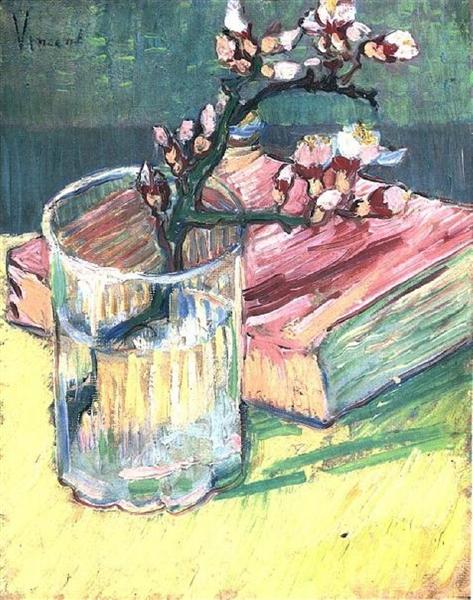
Blossoming Almond Branch in a Glass with a Book, Vincent van Gogh
October’s bright blue weather seemed to be good for reading. I read most of Salt to the Sea in August, and started Return of the Native way back then, too. It took me about 7 weeks. The other books were fairly quick reads. I included them all here to get caught up and that’s why this list is longer than usual.
Among the Shadows: WOTY (Beauty)
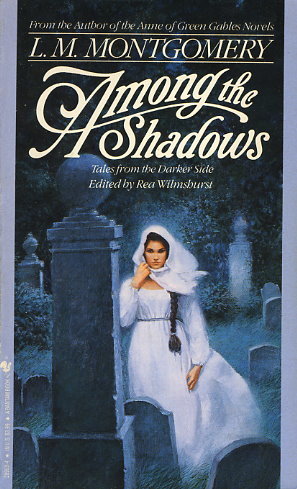
Among the Shadows by L. M. Montgomery, 1990, 280 pages
The day was well on to late afternoon in mid-spring, and the whole world was abloom. Before him and behind him wound a road that ran like a red ribbon through fields of lush clovery green. The orchards scattered along it were white and fragrant, giving of their incense to a merry south-west wind; fence corner nooks were purple with patches of violets or golden-green with the curly heads of young ferns. The roadside was sprinkled over with the gold dust of dandelions and the pale stars of wild strawberry blossoms.
Nothing like L. M. Montgomery to set you down in some ideallic pastoral scene. Here’s another soothing word picture:
One September afternoon in the year of grace 1840 Avery and Janet Sparhallow were picking apples in their Uncle Daniel Sparhallow’s big orchard. It was an afternoon of mellow sunshine; about them, beyond the orchard, were the old harvest fields, mellowly bright and serene, and beyond the fields the sapphire curve of the St. Lawrence Gulf was visisble through the groves of spruce and birch. There was a soft whisper of wind in the trees, and the pale purple asters that feathered the orchard grass swayed gently towards each other.
Among the Shadows is a collection of nineteen short stories. The subtitle says Tales from the Darker Side and these are stories of ghosts, murders, drunkards and burglaries, some with unexplained phenomana and others neatly interpreted by circumstance. My favorite, The Redemption of John Churchill, begins with the first quote above. It contains a simple conversion story very naturally told.
Frankenstein: Classic
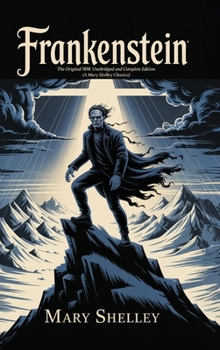
Frankenstein by Mary Shelley, 1818, approx. 280 pages
Frankenstein was written by Mary Shelley when she was nineteen or twenty, in answer to a challenge on a stormy weekend in a cabin in the mountains. Lord Byron, Mary and Mary’s husband, Percy Shelley were confined to the fireside and challenged each other to tell a ghost story.
Victor Frankenstein is a very bad father to his ‘creation’. I think Victor is the real villian, although he isn’t portrayed as one. He had this great ambition to create life, a better species than had been created, but he had no imagination to concieve how that might go. He always thinks he knows what will happen and he is always wrong.
I often sympathized with the ‘creature’ he made, who doesn’t even have a name.
I was glad when I was done reading it! It felt so hopeless. Then I read some other reviews and started to see the story differently. Victor represents science and logic, which had a great following in Shelley’s day. Science was believed able to solve all of mankinds problems. But if science is the ulitmate, children and women are in danger; art, language, culture will die, love is stifled. This is illustrated with the different deaths in the story. Science relies on what can be measured or proved. But history should balance it, because history reveals how humans act. Behavior cannot be measured, but it can be predicted.
If nothing else, you can read this for the awesome, majestic, sublime nature descripions. Parts of the book take place in Geneva, Switzerland, in the frozen north pole, and across Europe. Shelley included these descriptions as a contrast to the sterile logic of science.
I had a similar experience reading this classic as I do a lot of them. The actual reading is not particularly pleasant, but several days after finishing and thinking about it, the book takes on a certain glow. There is more to it than the sum of it’s parts.
Salt to the Sea: LOL Bookclub
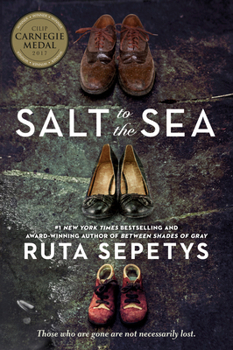
Salt to the Sea by Ruta Sepetys,2016, 448 pages
This story recalls the events of war that led to the sinking of the Wilhelm Gustoff, a ship overloaded with refugees crossing the Baltic Sea during World War 11, on January 30, 1945. It was sunk by a Russian torpedo. Thousands of German soldiers, naval personnel and civilian refugees were fleeing the advancing red army. The vessel sunk rapidly after being struck, and freezing temperatures rendered many lifeboat winches unusable. Out of more than 10,000 on board, as many as 9,000 lost their lives. Just over 1000 survivers were rescued.
The story follows four fictional characters whose lives converge on the ship where their fates are sealed. Through their trials and joys, the tragedies of war are starkly revealed.
The Return of the Native: Classic
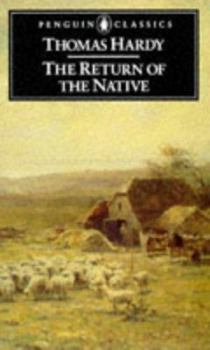
The Return of the Native by Thomas Hardy, 1878, 401 pages
The Return of the Native begins with a chapter describing Egdon Heath that reminds me of Genesis 1 in its authority. The falling darkness in a land as old as time on a day toward the close of the year hints at the trouble and darkness to follow, the sense of time winding down. Maybe it reminded me of Genesis because it was so opposite of Genesis.
In 1840, Clym Yeobright returns from Paris to his native Egdon Heath in England. Over the next ten years, various love triangles play out with varying degrees of success. Actually, mostly without success.
Hardy’s philosophy of life was that humans always lose, no matter their ambitions and goals. This was certainly true for the main characters, but the lesser ones seemed to have more satisfactory lives.
My favorite character was Egdon Heath. If you read this book, read it for the descriptions of the countryside which seems to be most often dark. You emerge from this book feeling like you were inching along a precipice. Bonfires, ferns and patches of furze mark the land and reflect back to the characters their feelings and dreams. Even when the sun shines or lantern light is seen, it creates a lot of shadows. Wind, weather and fire are personified as active companions. People are a mere transitory spot on the land’s enduring surface.
This sounds depressing but it isn’t, really. To repeat how I felt about Frankenstein, I’m learning that classic novels pull the reader out of his comfort zone. In spite of the ‘discipline’ required to read them, when it all comes together at the end, there is so much to think about.
One of the lessons of this book is, when people advise you about marriage, they probably actually have your best interests in mind! They may be able to see some things that you are blind to. Classic books would be much better read before marriage than romances. Many classics center around marriage and what makes them work and how they can crumble. In the romance genre, the whole book leads up to ‘happily ever after’. In a classic, the characters marry for love, or money, or prestige, or any number of things, but the ‘story’ is how this plays out in the couple’s married life, and it’s usually not how they think it will.
Leaving a Trace: Nonfiction
Leaving a Trace by Alexandra Johnson, 2001, 240 pages
From the description on the back of the book:
Whether you’re preparing to make your first journal entry or you’re a seasoned diarist, this practical, inspiring, one-of-a-kind guide can enrich your experience of recording your thoughts and impressions of the world around you. Leaving a Trace brims with helpful tips and techniques on everything from getting started to avoiding writer’s block to transforming your journal into a larger creative work: a family chronicle, a memoir, or a novel.
“Because a journal is usually a private affair that offers little opportunity for discussion, people seeking direction on keeping a successful one should welcome this thoughtful guidebook. Apt remarks by Virginia Woolf, Tobias Wolff, Annie Dillard, and others add to Johnson’s perceptive and often humorous insights. —Publishers Weekly
I read this book quickly in a few days to get the whole gist of what the author had to say. One suggestion I put to use immediately —a method of indexing a journal. It is my intention to reread it, incorporating more of the ideas and exercises. It was a delight!
Married to a Bedouin: LOL Bookclub, Nonfiction
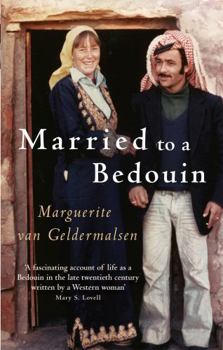
Married to a Bedouin by Marguerite van Geldermalsen, 2006, 276 pages
On a vacation in Petra, Jordan, with a friend, 23-year-old Marguerite van Geldermalsen meets and falls in love with Mohammed Abdallah. She abandons her former life in New Zealand, marries Mohammed and moves to Petra, living in a cave like the Bedouins and adapting to their ways of life.
In our discussion at bookclub, we wondered if she had included mostly the happy things and left out the troublesome things. We talked a lot about how comfortable we are with adventures and what had been the greatest adventure of our lives so far. Most of our adventures had something to do with travel.
Happy reading! Liz

