
Christina’s World, Andrew Wyeth, 1948, Contemporary Realism
A lawn is nature under totalitarian rule. -Michael Pollen in Second Nature
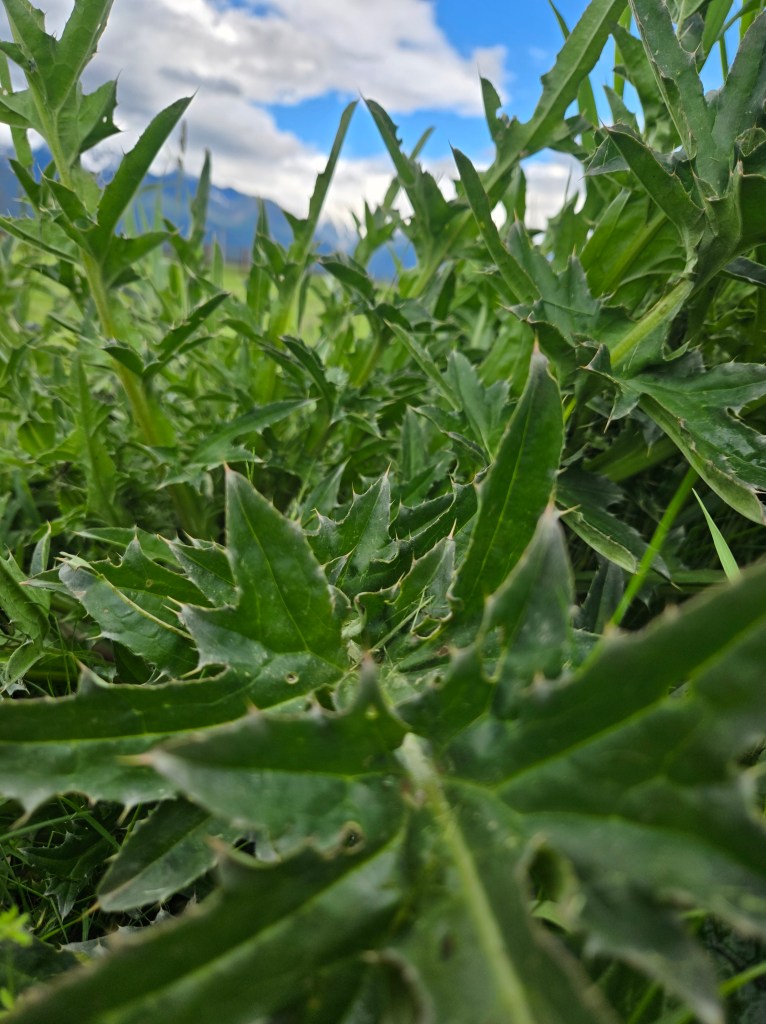
Apparently, our yard is particularly suited to the thistle. I have never seen such huge, healthy plants. The stems are easily an inch in diameter, the leaves are a foot long and three inches wide, with every tooth embellished with a sharp point. They are fascinating, like a snake is fascinating, and produce the same zero-at-the-bone sensation.
The thistles seem to have multiplied after my experiment with letting the grass grow. A couple of summers ago, I didn’t want to mow the entire five acres we live on. I like to ask why instead of just doing what everyone else does, and so I questioned why I should mow from road to fence and back again. I grew up on tall grass prairie and sorta miss it sometimes. I pictured the sea of grass, rustling ocean of my childhood, and myself in a bonnet crossing the prairie.
It takes a lot of gas and a lot of time to mow so much lawn. We were only mowing pasture, the native grasses that had been growing here a long time. While building on the property, we had driven over it anytime we wanted and dug in various places and the ground was bumpy. There was some nocturnal, subterranean creature that kept leaving mounds of fine dirt that filled the air with dust when I hit them with the mower.
Every time I mentioned doing something about the yard, my husband would say something like everything in it’s time. Or we have other priorities now. I told him how hard it was on me. I needed a sports bra to mitigate the jouncing. I came in completely dusted with fine dirt. The dandelion seeds were choking me. He smiled. I appealed to pity for his lawnmower. The ground was so rough one or two wheels would be in the air sometimes. I was worried it was hard on the frame. He seemed unconcerned.
I had been reading a book about human’s relationship with their surroundings and had picked up some ideas that seemed sensible on paper. This author didn’t endorse the totalitarian rule that seems to be the standard of industrious people. He wrote that every yard and park should make the most of whatever natural features they already had. Otherwise the gardener would be in a constant battle with nature to make it conform. Well, we had grass. Grass was the one genius my yard excelled in.
Consult the genius of the place in all. – Alexander Pope
I mowed around the house and let the grass grow farther afield.
I loved it. I had my sea of grass and it waved to me in the wind. I mowed a curvy swath and one small circle in a far corner. I could walk easily along the mown path or take my exercise mat out to the circle and no one could see me in all that grass. For a yard that had nary a tree or fence, this felt like a secret garden and I took a childlike pleasure in it.
Then I noticed, above the tall grass, another plant of a bluish green color and particular scaley flower bud.
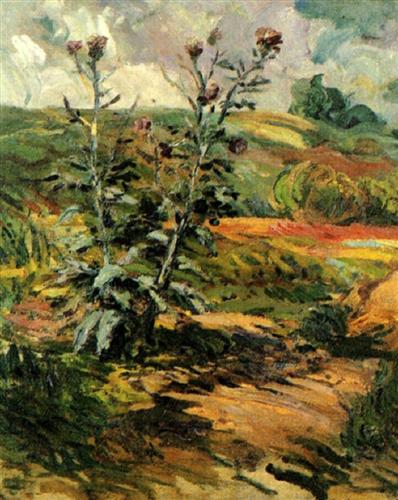
Two Thistles, Vincent van Gogh, 1888
The thistles were loving it, too. They grew and put on big purple pin cushion flowers. I sensed the danger and made an attack with my shovel. About five to seven thistles fit in the wheelbarrow. My mantra as I sweated it out was: Made a difference to that one.
A weed is a plant growing where I don’t want it to grow. So in another location, a thistle has redeeming qualities, they say. Thistles provide food for pollinators, support birds with their seeds and down for lining nests. For humans they have provided food (thistles are related to artichokes) and tinder. (I hope I never get that hungry.) Thistles provide a lesson in tenacity, as the plants will grow from the smallest bit of root left in the ground. The thistle is Scotland’s national flower—an enemy stepped on one and the resulting yelp alerted the Scottish clansmen and aided in saving the country. It was, in ancient times, considered a plague remedy and a good luck charm, mostly unsuccessful and uncomfortable, it would seem.
I think what I have growing here is actually a Bull Thistle. I found it in my Rocky Mountain Wildflowers Field Guide. To quote the book: “This is our only thistle with upper leaf surfaces covered with short stiff hairs. The first blooms appear about the time half-grown Uinta ground squirrels are seen scampering around meadows or crossing highways.”
This is making the thistle sound a little more interesting than I meant it to be. And now I wonder if an Uinta ground squirrel is leaving those little mounds of dirt on my lawn. I will keep an eye for them at thistle blooming time. That is, if any thistles escape my mower and happen to bloom.
To continue this short history of mowing.
Midsummer, a neighbor with a small tractor came to mow our tall grass. Then it rained a couple times before he got it baled into small square bales. There were 80 of them and I felt like a rich farmer. The whole process was so pastoral and bucolic and completely down my line. I thought.
The farmer moved away. It had been a hassle to find and hire him and we didn’t know of anyone else to mow the sea of grass. Our chickens had moved on also and didn’t need bedding or perches. So the next spring I mowed everything and accepted my role as absolute dictator. It requires constant vigilance.
This year I mowed around the house a few times and in the process (we get a lot of rain in the spring and the grass grows fast) a large part of the yard got away from me. Just when I should have mowed it, I had other priorities because my mother was visiting me. Her visit coincided with a dandelion outburst, but that is another story.
My mother went home and I was left with a lot of tall grass.
The last few days have been spent mowing foot tall grass and staring into the depths of those huge thistles. The other day I went out to mow three times, once coming in when it was sleeting. I had been hoping it wouldn’t rain but hadn’t thought to be worried about sleet. I went out for short stints of mowing when the sun shone. Another day I mowed in flip flops and short sleeves. And today it was boots and a heavy sweater and still feeling cold a lot of the time. This fails to portray the angst I have suffered because of grass growing. Or the victory I feel after winning this week’s battle.
There’s a large patch that looks like a child tried to cut his own hair, and it would benefit from another pass. Maybe I will get to it before the weekend. All that’s left is to maintain it with a weekly pass of the mower that may take several hours and quite a lot of gas. But I do feel more civilized. And from a distance it has the ‘unmistakable odor of virtue that hovers over a scrupulously maintained lawn.’
Further, he (the gardener) knows that neither his success nor his failure in this place is ordained. Nature is apparently indifferent to his fate, and this leaves him free—indeed, obliges him—to make his own way here as best he can. -Michael Pollen in Second Nature
-Liz